before the second sleep, the mind flits between prayer, poetry and power games planning for the ways we will be silenced, keeping watch, anticipating the move to bring us back to relevance the poetic transformation of nothing
to something. from fear to action. the promise of persistence, the hope of composting grief into growth, making order from disorder. to whom these prayers are directed
I don’t know. an awkward plea to the blank and pitiless sky. a baby’s cry to the bowels of the planet that we, steel race of woman born, gifted fire, gluttons for crude, make hotter than the forge of Hephaestus or screaming rubble after the latest pass of the war machine.
let us mean something let us matter against entropy let this not all be in vain – carbon thinking and speaking to carbon, via silicon, about its life in the shape of a human – the universe’s ongoing conversation with itself, electromagnetic internal monologue of creation, trying daily to talk ourselves out of self-destruction
this tending to chaotic evolution, indivisible from story. the third event to the nth degree before and beyond history, we prepare by stocking wood in summer since winter always comes.
During the UK COVID19 lockdown of Summer 2020, some new work of mine made its way into the world.
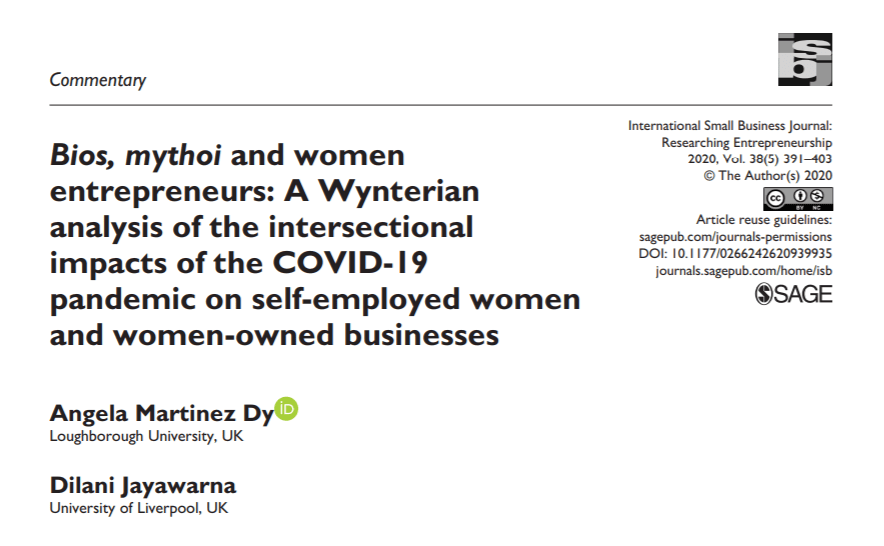
First is an ISBJ commentary on the expected effects of COVID19 on women’s entrepreneurship; second is a timely polemic piece in Organization written by the BARC Collective on the racist nature of Business Schools, which came out during the international uprisings in defense of Black lives. Both publications are available open access for free reading and download.
Next is a BARC chapter on the relationship between collectivity and radicality, in an edited volume on social justice work by women of colour in academia. Finally there are two chapters in a new critical realist gender reader, one of which is a reprint and a new one (written in 2017 – so glad it’s out!) on gender, trans politics and affordance from a critical realist feminist perspective.
An additional publication on sociological reflections on COVID19 life was accepted in August by The European Sociologist and is in press – I will update this post when it is published.
Decolonial philosopher Sylvia Wynter theorises the human animal as formed by both bios and mythoi, or matter and meaning. This article adopts this ontological perspective to explore the effects of the COVID-19 crisis on UK self-employed women and women-owned businesses through an intersectional lens accounting for race, class and gender. We argue that unequal health outcomes from COVID-19 are not solely biological; rather, they are also the outcome of social inequalities. Drawing upon the Wynterian elaboration of Fanon’s work on sociogeny – the shaping of the embodied human experience by the norms of given society – to explain this phenomenon, we contend that the same inequalities emerging in health outcomes will be reflected in entrepreneurship and self-employment. Drawing on Labour Force Survey data for the past decade, we peer through the Wynterian prism of bios and mythoi to argue that marginalised entrepreneurs are likely to experience extreme precarity due to COVID-19 and so require targeted support.
In this essay, we call upon our fellow scholars of colour to recognise the ways Business Schools are structured by white supremacy and actively de-value our knowledge and experiences. Alongside this recognition, collective action led by scholars of colour is needed to build intergenerational support systems which will be key to dismantling racialised power structures as they appear locally and transnationally. White scholars are invited to listen and learn from this call.
A sequel to ‘Inside the Ivory Tower: Narratives of women of colour surviving and thriving in British academia’ (2017). These research case studies by Black women academics describe the transformative work of contributors to the Ivory Tower project, adding intersectional voices from the United States, Canada and Australia, and LGBTQ perspectives. Privileging their lived experience, intellectual, social and cultural capital, they recount the self-defined pathways for social justice developed by women of colour. Drawing on critical race theory and Black feminism, the authors navigate challenging spaces to create meaningful roles in addressing race and gender disparities that range from invisibility in the academy to tackling female genital mutilation. Their research and practice, so often unacknowledged, is shown to be transforming teaching, research, professional and community practice within and beyond the academy.
Ch. 5 Gender Theory Non-conforming: Critical Realist Feminism, Trans Politics, and Affordance Theory – Angela Martinez Dy
Ch. 6 Developing a Critical Realist Positional Approach to Intersectionality Angela Martinez Dy, Lee Martin, and Susan Marlow
In assessing the current state of feminism and gender studies, whether on a theoretical or a practical level, it has become increasingly challenging to avoid the conclusion that these fields are in a state of disarray. Indeed, feminist and gender studies discussions are beset with persistent splits and disagreements. This reader suggests that returning to, and placing centre-stage, the role of philosophy, especially critical realist philosophy of science, is invaluable for efforts that seek to overcome or mitigate the uncertainty and acrimony that have resulted from this situation. In particular, it claims that the dialectical logic that runs through critical realist philosophy is ideally suited to advancing feminist and gender studies discussions about broad ontological and epistemological questions and considerations, intersectionality, and methodology, methods, and empirical research. By bringing together four new and eight existing writings this reader provides both a focal point for renewed discussions about the potential and actual contributions of critical realist philosophy to feminism and gender studies and a timely contribution to these discussions.

 Dr. Angela Martinez Dy