Reflections on IACR 2024 Gender Roundtable: A Critical Moment for CR Gender Studies?

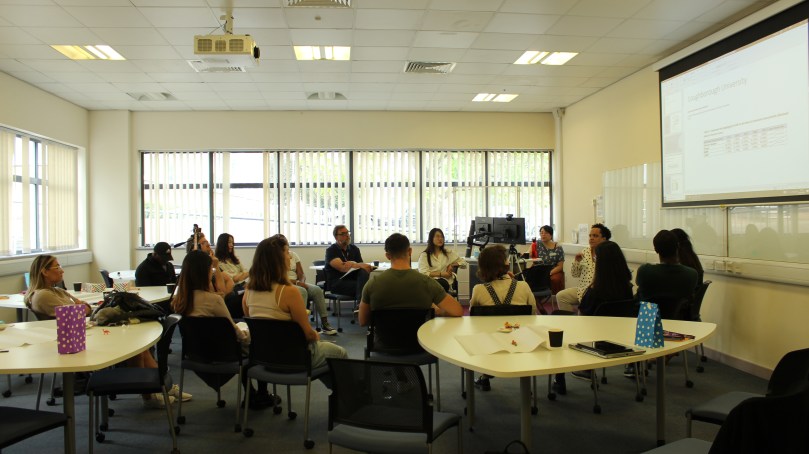
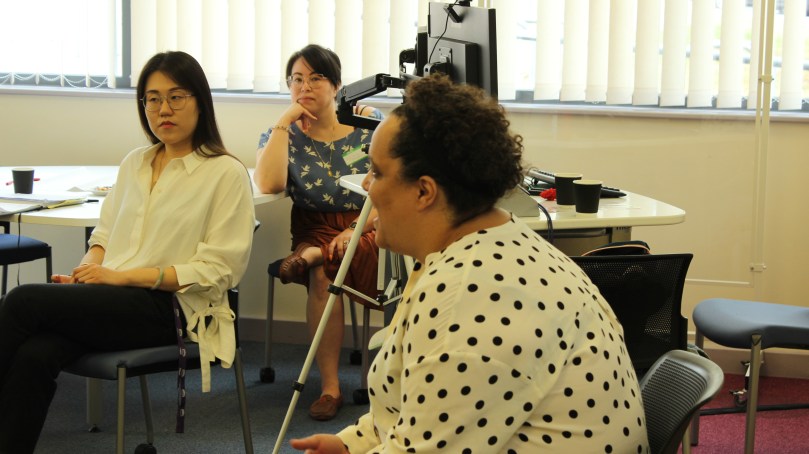
As a panel participant of the Gender roundtable that took place at the International Association for Critical Realism (IACR) conference on Friday August 2nd 2024 at the University of Warwick, I understood this event as a critical moment in the trajectory of CR gender and feminism studies. I document the presentations and something of the discussion that followed, and set out my commitment to continued generative dialogue in the face of potentially divisive philosophical differences.

As I have written elsewhere with colleagues, gender studies and feminism finds itself in crisis over a series of debates that to some may seem unresolvable. The casual efficacy and continued relevance of the body and materiality is something that critical realists bring as a challenge to discourse-centric poststructuralist feminism. Our panel brought this topic to the fore from different angles: Steph Grohmann discussing how gender, once considered emergent from sex, seems to have in late stage capitalism become its progenitor, Caroline New reaffirming both the centrality of sexual dimorphism and the fluidity of gender, while noting the challenges of generating meaningful listening and discourse between radical feminists and trans activists, Ngozi Cadmus exploring the potential for distributed corporate agency of Black women in C-Suite executive positions, and Michiel Van Ingen introducing scholarship on social reproduction theory and masculinities to CR debates. For my part, I applied the CR depth ontology and the structure-agency-culture model to intersectional organisational inequality regimes. I was grateful to the audience for introducing additional relevant theory and concepts, as well as suggestions of inclusive practice, to further stretch our thinking.

Importantly, our panel was one of the most racially and gender diverse panels of the conference. This was by design, an intentional choice which was achieved by facilitating the participation of panellists focusing on intersectionality, and including an early career researcher. I agreed with one of the audience members that inclusive panels are achievable with care and effort. As a result of what took place both at our panel and during the AGM earlier in the conference, wherein women early career researchers highlighted the exclusivity of all-male panels and the lack of action since these issues were raised the year prior, I suggest that the IACR organisers have a strong responsibility to improve attendees’ experiences by standardising and exercising inclusive practices. That this was a subject of discussion that emerged in response to our panel happened because there were few other places to raise it. I hope IACR leverages the expertise, positive comments and collaborative energy that was shared in the discussion to form a regular means by which inclusivity can be improved.

Central to the debates in our panel was the issue of gender ontology, and how theorising about contemporary topics of sex and gender such as those regarding trans, intersex and nonbinary issues affects real people, and members of our communities. What I tried to make clear in my contributions to the discussion was that while we are indeed all affected by these concerns, we are affected in different ways and to different degrees.

Positionality matters, and our philosophical undertakings have real world implications. In that spirit, while I acknowledge that we may not agree with each other’s stances on sex and gender, and that we may not be able to bridge our ontological positions, we can commit to building an ethical bridge where we aim to reduce harm and violence that occurs as a result of people’s beliefs and behaviour around gender, and to centre those at most risk, while not ignoring effects on others.
Let’s Get Free

LU 2023 Freedom School Promotional Video

I owe a big part of my early political education to a Freedom School. In 2001, at age 18, I was a student in the Tyree Scott Freedom School organised by Seattle’s Youth Undoing Institutional Racism, and the experience was deeply formative. I had already been a member of the isangmahal arts kollective for years, a teenage artist-activist making spaces for Filipinx voices and voices of colour with other youth mentors and role models, and had co-founded the youth branch of the organisation which would eventually evolve into Youth Speaks Seattle. However, I had not yet been exposed to the possibilities of liberation pedagogy, or education as a means of freeing, rather than inculcating, the mind.

My Freedom School Summer was the first time I had entered an explicitly anti-racist educational space. I remember in particular taking workshops on understanding structural privilege and the history/present of Palestinian occupation. This critical exposure to geopolitical power dynamics was especially relevant in a Seattle that, only two years prior, had taken to the streets to protest the World Trade Organisation Ministerial Conference 1999. Although I wasn’t permitted to join the protests (thanks Mom for keeping me safe at home), the spirit of radical resistance against what we might now call racial capitalism resonated throughout the city, and the momentum of social movements at the turn of the new millenium was galvanizing.

That same summer, the community of Asian and Pacific Islander artists with whom I collaborated hosted the first Asian Pacific Islander American Spoken Word and Poetry Summit, a groundbreaking conference that shaped the trajectory for an anti-racist spoken word and poetry movement to usher in the 21st century. My sharp memories of the Freedom School Summer, such as doing the ‘privilege walk’, inviting my newfound friends back to my housing complex to hang out, and later protesting swimming pool racism, are intertwined with memories of huddling up with other young women poets as the artists on stage wove us together with song, and spilling onto the streets of the International District listening to APIA poets interrogate, dissect and deconstruct toxic and violent histories of colonial militarism, and examine the complex resilience and determination to survive it produced, in their and their families’ countries of origin. Moments like this gave me my first taste of freedom from the systems of oppression that have, decolonial scholars remind us, existed since the modern era began with Columbus and his men landing in the Caribbean in 1492.

In these settings, I knew I was wanted and welcome, body, mind and soul. The connection and community I experienced there set my life’s bar for what freedom felt and looked like. This community wanted what I had to give, and its gifts were transformative. It is from these origins that I came to co-create the Building the Anti-Racist Classroom Collective, which from 2018-2021 designed and delivered a series of anti-racist educational workshops (#BARCworkshop) which developed new teaching and learning methods, and established intergenerational support systems, for anti-racists at work in higher education. We imagined such spaces, and knew they were possible, but entirely too rare. So when the Pro-Vice Chancellor for Research at Loughborough University asked me in early 2022 what I would like to make happen using a budget from the Research Culture Fund, I did not hesitate in saying I wanted to create a Freedom School in order to grow the anti-racist and decolonial knowledge base and skill level of the University community.

Building on focus groups with Loughborough Doctoral Researchers (DRs) from backgrounds of colour where they highlighted a hostile, institutionally racist research environment, I partnered with Dr Addy Adelaine, CEO of knowledge creation and sharing organisation Ladders4Action, doctoral researchers Rhianna Garrett and Iman Khan, and Nottingham artists Emily Catherine and Thomas Higgins, to generate a pilot Freedom School benefiting Loughborough DRs. We co-created this in collaboration with Black, Asian, and Minority Ethnic (BAME) DRs, who were compensated fairly for their time and expertise, and ran two pilot workshop days in July 2022, across the Midlands and the London campuses.

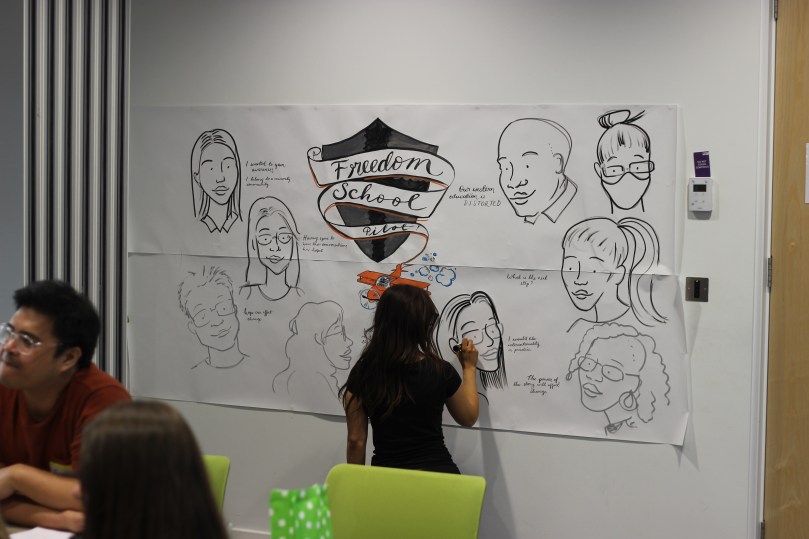
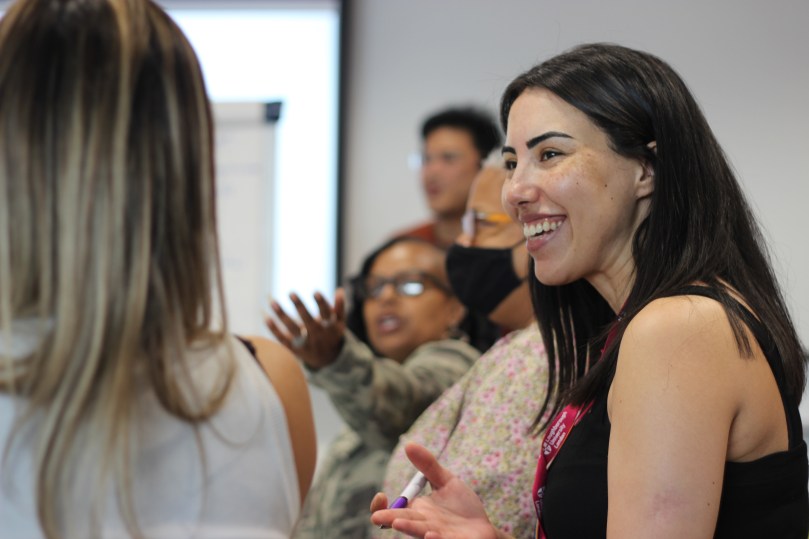
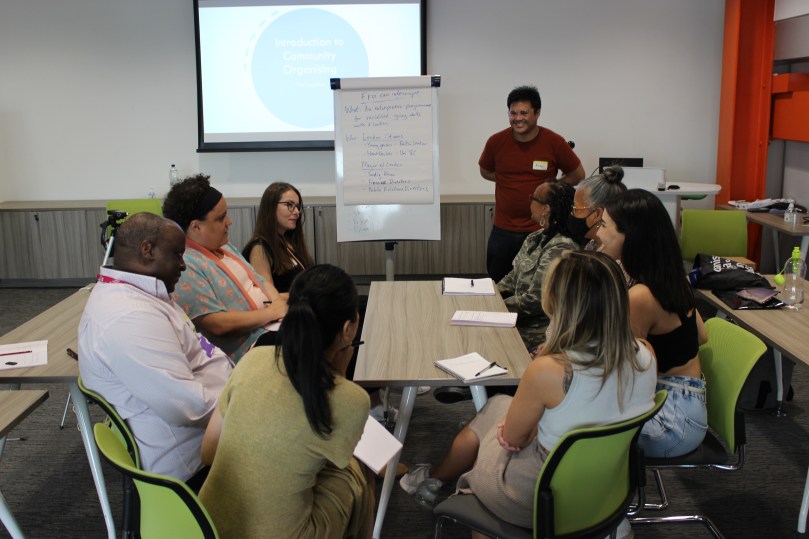
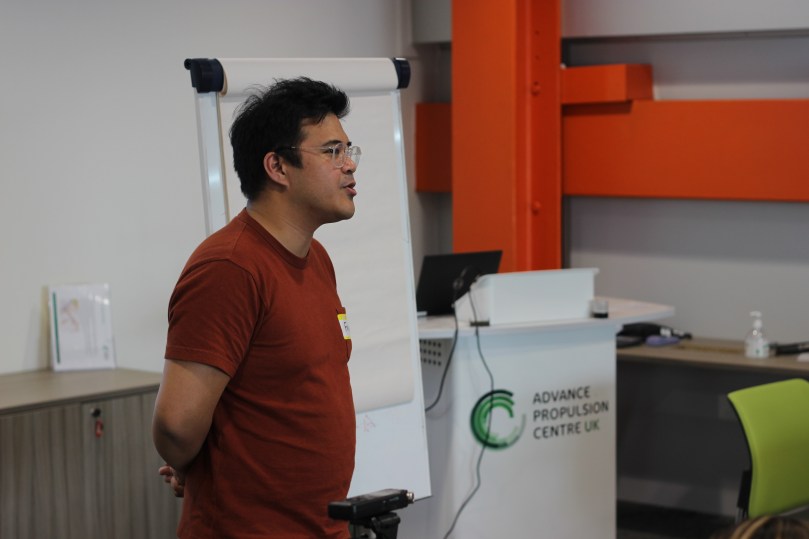
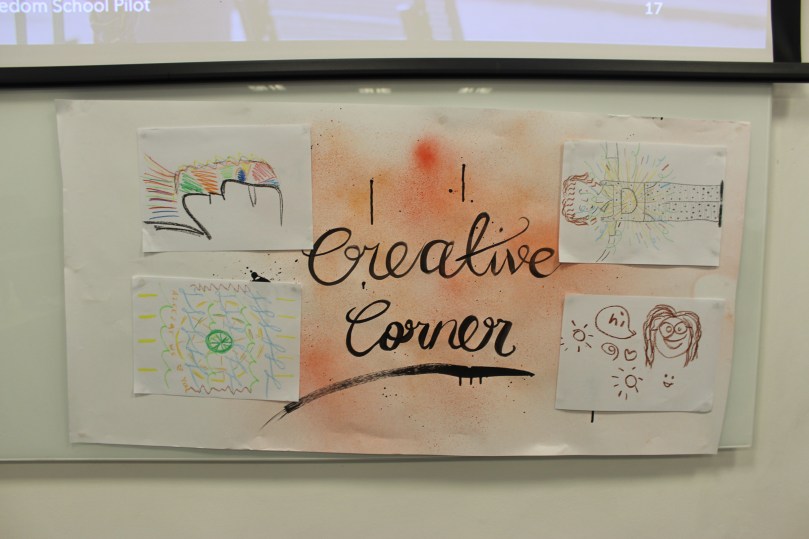
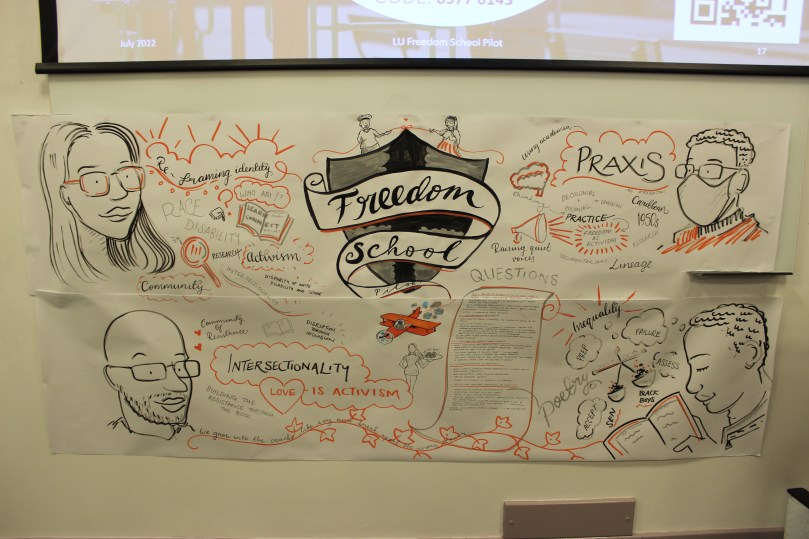
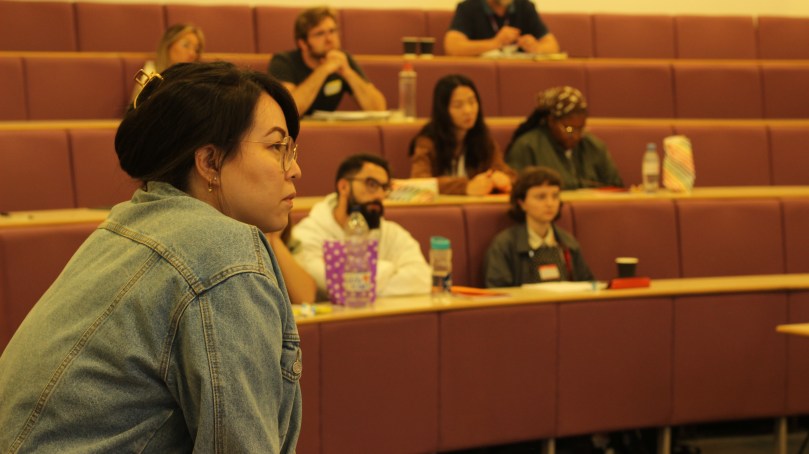
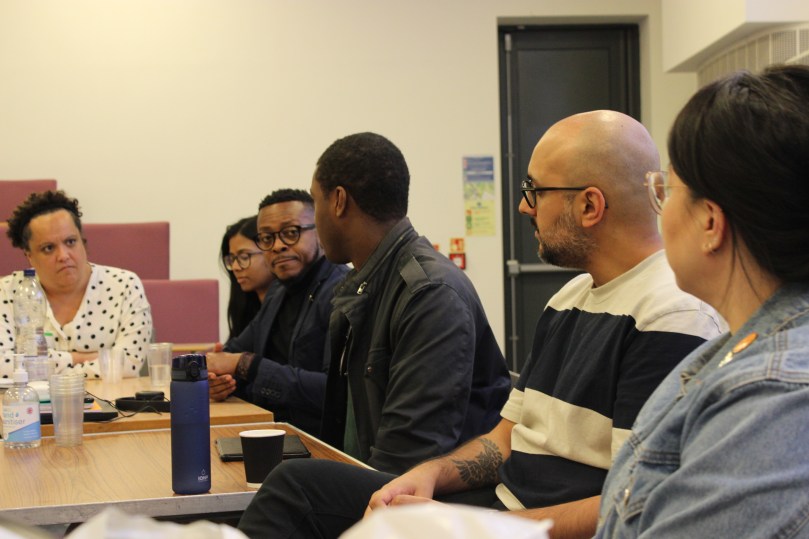
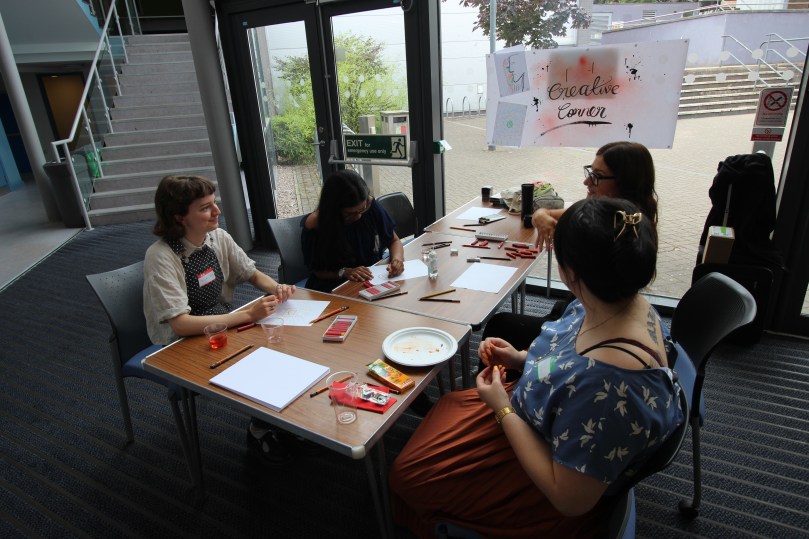
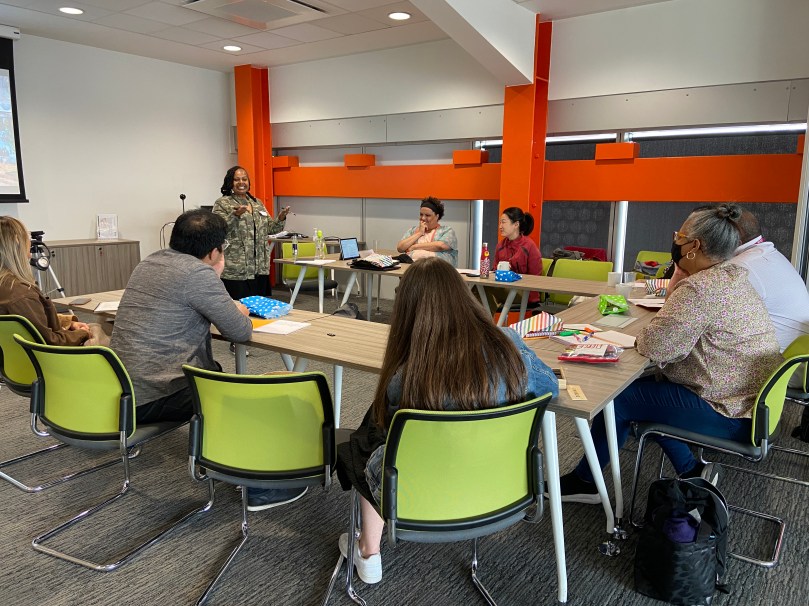
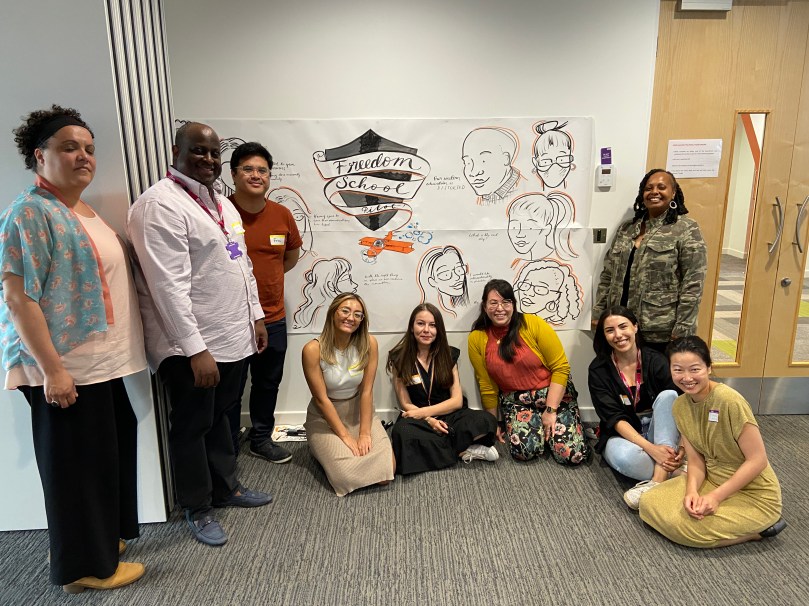
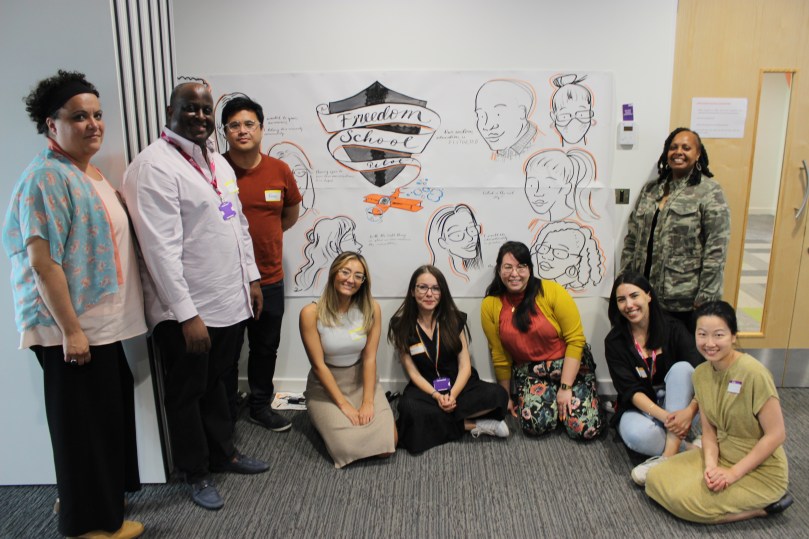
We complemented their insights by drawing on our wide range of previous experiences of anti-racist and radically inclusive higher education pedagogy. Through this, we demonstrated to the doctoral researcher attendees that academia does not have to be the isolating, competitive, stultifying place it can often seem, but can be a stimulating and vibrant space where time, thought and resources are given to empowering as well as educating all in the room. We documented our work in this recently published report and the images in the slideshow below. A promotional video capturing the creative and energising feel of the event is available here, and a news article on its success was published by the University.

The in-person events of last summer are soon to be capped off by a final virtual event next week in partnership with inclusive marketing specialist Joyann Boyce, entitled Freedom School Online: Build Your Reputation and Your Community. I am grateful for the support of Loughborough’s new EDI team and the culture of openness towards equity initiatives created in recent years at our institution. I look forward to delivering a session with Iman and Rhianna on the importance of building anti-racist academic community through creative methodologies, and highlighting some of the many projects and initiatives that continue to inspire me as an anti-racist feminist scholar-activist of entrepreneurship, technology and culture, and my ongoing journey towards intellectual, creative and spiritual freedom.

LU Freedom School Pilot – 28 and 31 July, 2022. Photos: Thomas Higgins