
Just Published! Critical Realism and Intersectionality

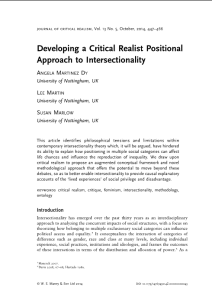
A preview of the published articleI am happy to share that I have just published an article in Journal of Critical Realism’s October 2014 issue.

Abstract: This article identifies philosophical tensions and limitations within contemporary intersectionality theory which, it will be argued, have hindered its ability to explain how positioning in multiple social categories can affect life chances and influence the reproduction of inequality. We draw upon critical realism to propose an augmented conceptual framework and novel methodological approach that offers the potential to move beyond these debates, so as to better enable intersectionality to provide causal explanatory accounts of the ‘lived experiences’ of social privilege and disadvantage.

Keywords: critical realism, critique, feminism, intersectionality, methodology, ontology

Reference: Martinez Dy, A., Martin, L., Marlow, M. (2014) Developing a Critical Realist Positional Approach to Intersectionality. Journal of Critical Realism, 13(5): 447-466.

Getting Involved with Gender and Enterprise Network

GEN logoI had the pleasure of spending some time last week with members of the Gender and Enterprise Network (GEN) of the Institute for Small Business and Entrepreneurship (ISBE). I was attending a workshop entitled “Innovating Theory: Gendering and Extending Entrepreneurship Theory” with presentations by my awesome supervisor, the esteemed Prof. Susan Marlow, the pioneering gender and entrepreneurship scholar, Prof. Sara Carter of Strathclyde University, Prof Eleanor Shaw, also of Strathclyde, and Dr. Robert Smith, who is doing interesting and novel work on masculinities and entrepreneurship.

It was an excellent and thought-provoking couple of days, in particular for the sessions on future directions in entrepreneurship research, which included looking into entrepreneurial households and families, as well as  something that particularly excited me, which is exploring gender more widely, complicating it intersectionally, and challenging the heteronormative bias of research as it currently exists.

It also resulted in my joining the ISBE GEN committee as its inaugural Digital Communications Officer. This basically meant that I got to live-tweet the event (something I would have happily done anyway) and help build the group’s website (currently underway). I find it really refreshing to build relationships and network with other academics doing research in a similar area, as although we don’t always agree, you can say we “speak the same language.” I look forward to our future work together!