
‘Stay Home’ and Work? Implications of COVID-19 and the UK Governmental Response for Self-Employed Women

ISBEGEN blog

Co-wrote this blog post last week with my colleagues at the Gender and Enterprise Collective. Many self-employed women, especially founders of new businesses, won’t benefit from COVID-19 government support.
isbegen's avatarISBE Gender and Enterprise Network

The Gender and Enterprise Collective* (Haya Al-Dajani, Angela M. Dy, Carol Ekinsmyth, Sally Jones, Lorna Treanor, Julia Rouse, Natalia Vershinina)

Given last week’s government announcement of the stimulus bill meant to mitigate the effects of the COVID-19 crisis on the UK economy, it is important to recognise the implications for women broadly, and self-employed women more specifically. Such bills are notoriously gender blind, thus discounting the impact on the extent to which self-employed women are at most risk from the CV pandemic crisis. Further, self-employment is far from homogenous, so a blanket approach to support is insufficient. The self-employed contribute around a third of UK employment growth in the past decade; women-driven part-time self-employment has comprised most of this increase. Statistically, 34% of UK business owners are women; of these, 33% are sole-traders, 40% are in partnership businesses and 28% company-owners. There were 5.8 million registered small…

View original post 1,320 more words
Women’s Enterprise – What Next?

WEP

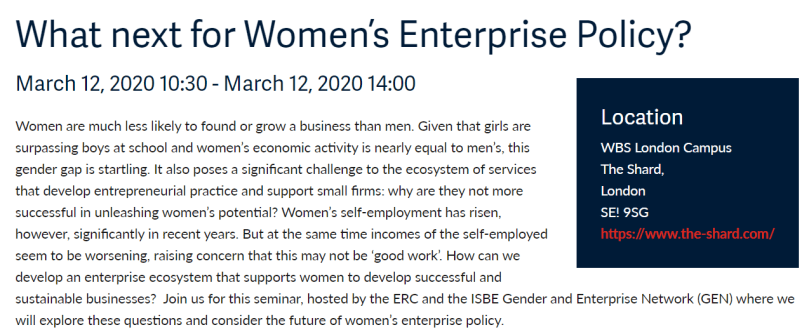
I will be presenting a State of the Art review on the future of women’s enterprise at The Shard in London on 12 March 2020.

My paper, co-written with Profs Dilani Jayawarna and Susan Marlow, is entitled: Is Expanding Women’s Self-employment A Good Thing? A Critical Reflection. The abstract is as follows:

Despite the increasing critical reflexivity and scope of the literature that study the influence of gender upon women’s engagement with entrepreneurship, a number of foundational debates persist to inform research efforts – that fewer women create new ventures and when they do, their ventures are more likely to exhibit poorer performance parameters and are less likely to grow when compared to the population male. Regardless of this, there is a generic presumption that entrepreneurship is a desirable career choice for women and moreover, society will benefit if more women become entrepreneurs. Within this SOTA review, we challenge the notion that entrepreneurship is a positive choice for women or indeed, necessarily generates broader socio-economic benefits. We base this argument upon the evidence that despite claims it offers women work-life balance, it can create new time pressures and generate poorer returns than employment, whilst individual employment or State provided benefits such as paid ante-natal support, extended paid maternity leave, subsidised child care are rationed or absent.

Register for the event here today!